


Financial Planning
Why devote time and resources to financial planning?
- It forces us to think about what to do with our money. It prevents our money from being used to further the aims of third parties and ensures that it is managed in a way that guides us towards our life goals.
- Avoid winging it. It reduces the chances of making mistakes. It helps us to understand ourselves and identify our current and future needs, to maximise our savings, and to take on debt responsibly and efficiently.
- Avoid getting into too much debt. There is no need to take out personal loans or make use of deferred payments on credit cards or revolving credit.
- It helps our wealth grow in the long term. Spending time on planning helps personal wealth grow by an average of 20% a year*.
- It reduces the likelihood of family disputes. It affects decisions on spending and saving, how to cope with times of crisis, income levels in retirement and the planning of succession.
- It goes beyond financial matters. It affects the family’s quality of life, relationships and even health.
- It is a powerful tool for combating the biases of impatience, the desire for immediate reward, and a lack of self-control.
WHAT IS PERSONAL FINANCIAL PLANNING?
What is financial planning?
Definition: It is a standardised process designed to enable consumers to achieve their life goals throughout their life cycle (section 3.14 of ISO 22.222). This process ensures a clear and effective framework for financial decision-making.
- A standardised process means that it complies with a technical quality standard*, in this case ISO 22.222 on personal financial planning.
- Achieving your key life goals throughout your life means planning for and anticipating current and future life events, and being prepared for the unexpected. This will enable you to reach retirement and beyond with the assurance that you will not have to lower your standard of living or rely on third parties such as the state or your children.
Personal financial planning is carried out in stages, covering different areas of focus; everything is explained in detail later on in the section on how the service is provided.
* In accordance with Article 8 of Law 21/1992, a technical quality standard is a document of voluntary application containing technical specifications based on experience and technological developments. … and must be approved by a recognised standards body.
How is the service organised?
In accordance with the ISO 22.222 Technical Standard for Quality, personal financial planning is carried out in six key steps, which are reviewed and adapted throughout the relationship between the client and the planner.
This approach is not limited to a list of actions; it is a comprehensive process that links all areas of a person’s financial life. From drawing up a budget to managing debt and investing, every step is designed to enable the client to organise their finances in a balanced way that is geared towards their life goals.
STEP 1: ESTABLISHING THE PROFESSIONAL RELATIONSHIP
Definition: It is a standardised process designed to enable consumers to achieve their life goals throughout their life cycle (section 3.14 of ISO 22.222). This process ensures a clear and effective framework for financial decision-making.
- The scope of the service.
- The professional qualifications and experience of the professional who will provide the service.
- The working method for demonstrating compliance with the technical quality standard.
- The basis for remuneration.
- Any conflict of interest.
- Completion deadlines.
- The duration of the contract.
- The frequency of contact.
- Confidentiality and data protection provisions.
Personal financial planning is carried out in stages, covering different areas of focus; everything is explained in detail later on in the section on how the service is provided.
* In accordance with Article 8 of Law 21/1992, a technical quality standard is a document of voluntary application containing technical specifications based on experience and technological developments. … and must be approved by a recognised standards body.
STEP 2: THE KEY OBJECTIVES
During the financial planning process, the financial planner will hold one or more face-to-face meetings with the client in order to identify and understand their life goals, both short-term and long-term. These meetings are essential for establishing direct and close communication, enabling the planner to obtain detailed information about the client’s financial and personal goals.
- Life goals: these are the activities or requirements that the customer will fulfil during the current year (up to the end of the calendar year).
- Future life goals: these are the needs that the customer wishes to meet or will have to meet in the future.
STEP 3: RESOURCES
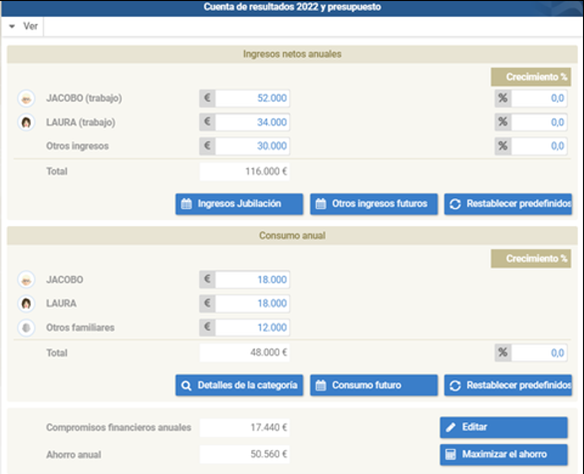
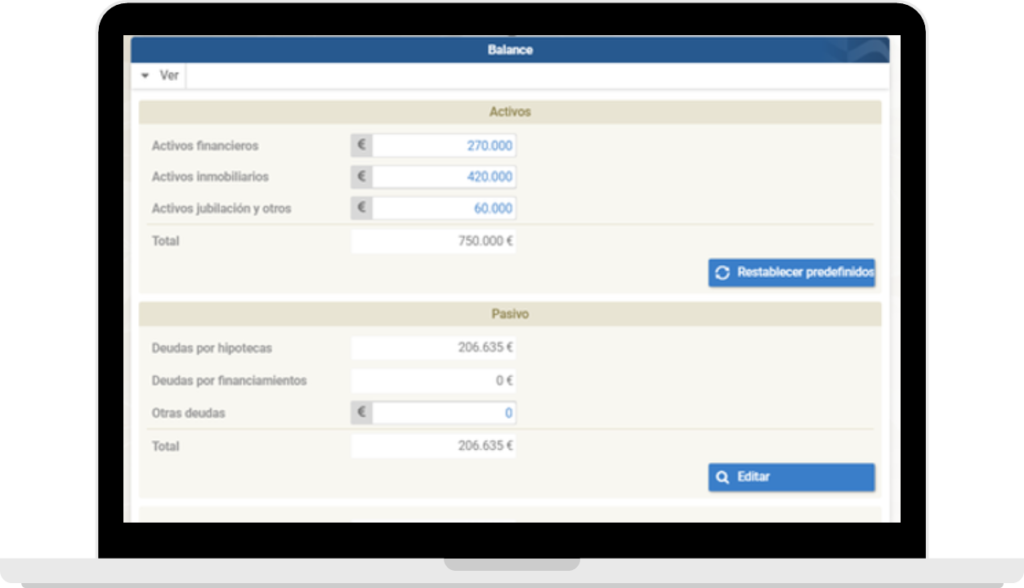
The planner must carry out and provide the client with, in a clear and reasonable manner, an assessment of the client’s financial and economic situation. This assessment shall be carried out using the balance sheet and the projected profit and loss account as tools.
- Balance sheet: It compiles and organises all the client’s and their family’s current assets and liabilities. With this information, you will gain a comprehensive overview of the client’s current financial situation and be able to understand their true financial position.
- Pro forma profit and loss account: forecasts the family’s future income and expenditure. It enables you to determine the desired level of savings required to achieve your financial goals and to assess the feasibility of your proposed financial plans.
STEP 4: STRATEGIES AND PRESENTATION OF THE PLAN
Now is the time to set out financial strategies for each key area: from organising your budget and protecting your assets and family with suitable insurance, to planning for retirement or drawing up an investment plan.
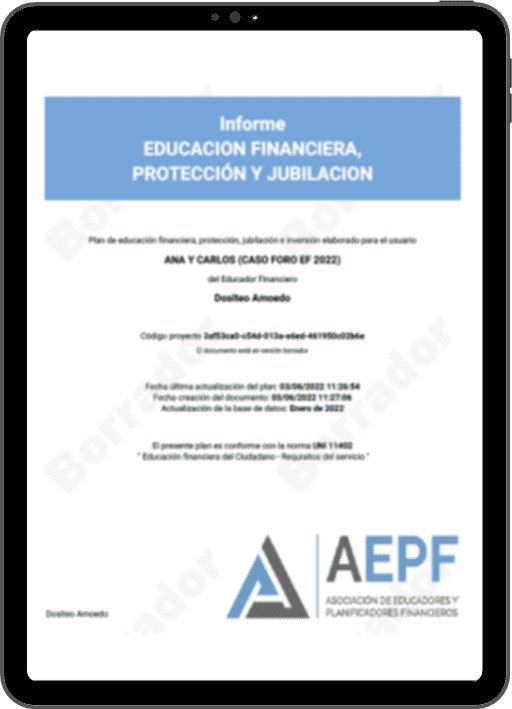
All these recommendations are set out in a Personal Financial Plan Report, a key document that provides a comprehensive and personalised overview of the way forward. Before it is delivered, the report is thoroughly reviewed and checked with the client to ensure its accuracy and clarity.
The planner is on hand at all times, answering questions and explaining each strategy, so that the client understands the plan and can implement it with confidence and commitment.
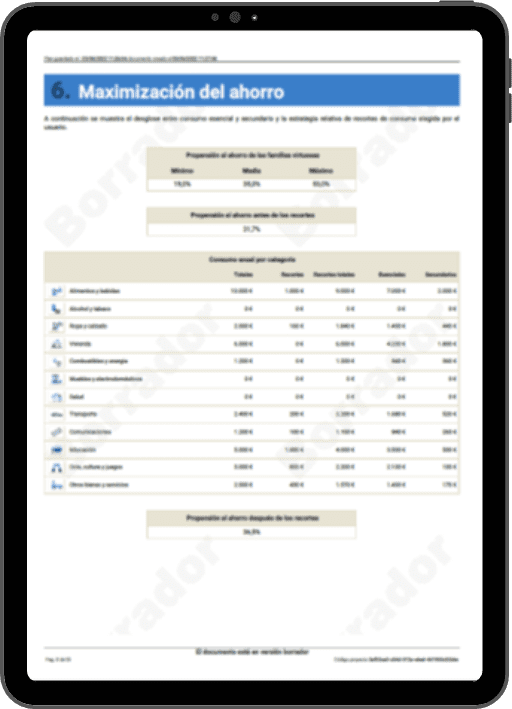
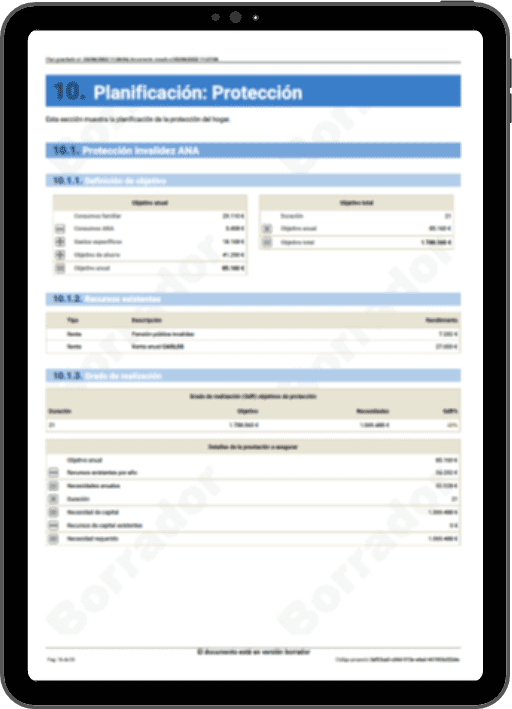
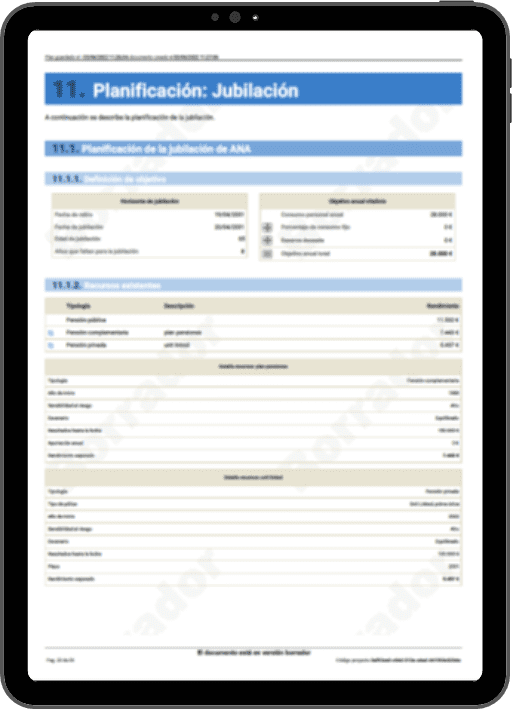
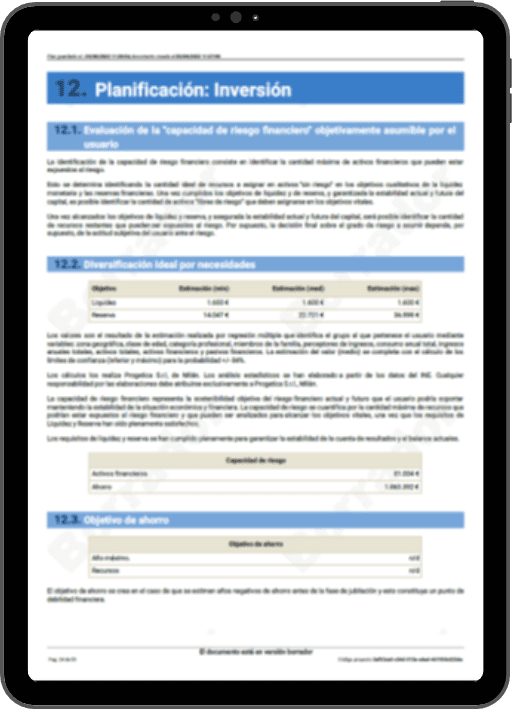
The Personal Financial Plan Report is a written document, personalised and tailored to each client’s needs and goals. It summarises the strategies for each area of focus and serves as a practical guide for effectively implementing the plan with the financial intermediaries chosen by the client.
- Steps to follow:
- Maximising savings.
- Economic stabilisation.
- Set the stability or contingency fund.
- Steps to follow:
- Set a target for your retirement income.
- Identify existing resources (public and private).
- Assess the need.
- Develop strategies involving complementary product types (PP), investment funds and private schemes (PIAS, pension schemes, rental income, other income).
- Steps to follow:
- Decide which assets and which family members need to be covered, and what types of cover (death and/or disability) are required for each person.
- Identify existing resources (public and private) for each contingency.
- Assess the need for private insurance cover.
- Develop strategies using in-house or external resources.
- Steps to follow:
- Firstly, determine the liquidity fund and the reserve fund.
- Then, using the available financial assets and savings, establish an investment strategy that is efficient, effective and consistent with the client’s life goals and risk appetite.
- Steps to follow:
- Set the borrowing target.
- Set the borrowing target.
STEP 5: IMPLEMENTATION OF THE PLAN
Implementation is the stage at which the plan is put into action. The planner works alongside the client to ensure the strategies are correctly implemented, reviewing their current financial products and assessing new proposals from banks, insurance companies or other intermediaries.
We analyse bank accounts, insurance policies, funds and investment plans in detail, assessing costs, terms and benefits, in order to recommend whether each product should be retained, adjusted or replaced. At the same time, we review new alternatives that may be better suited to the client’s objectives, always applying objective and transparent criteria.
Throughout this process, the planner ensures that the client understands every decision and feels supported when negotiating with intermediaries. Furthermore, the implementation involves adopting healthy financial habits: budget management, debt reduction and building up regular savings.
The aim is clear: to enable the client to put their plan into practice safely, confidently and consistently.
STEP 6: FOLLOW-UP
Follow-up is key to ensuring the plan remains relevant and useful over time. Life changes, and so do your finances, which is why the financial planner works alongside the client to adjust the plan whenever necessary. Follow-up includes:
Regular check-ups: recommended every quarter.
Special reviews: when there is a significant change in the client’s life (family, work, health) or in their financial circumstances.
Group sessions and ongoing communication: opportunities for shared learning, the provision of practical information, updates on regulatory changes and relevant opportunities to support clients’ financial education.
In addition, customers have access to Plafira, an online tool that makes it easy to update and monitor their plan at any time, ensuring accessibility and traceability. The aim is for it to evolve alongside the customer’s life and continue to serve as a guide towards their goals.
WHY SHOULD YOU USE A FINANCIAL PLANNING SERVICE?
Firstly, we need to realise that we need financial education and planning, as well as the tools and support of a professional.
It is not those who have less or earn less who need more help – not at all. Education and financial planning are just like health: it is up to the individual to look after their own health, and it is up to the individual to look after their own education and financial planning. Therefore, we must all be educated and have a financial plan, regardless of our income or wealth.
Secondly, we should take a look at ourselves and ask whether we are managing our assets as well as we ought to be.
We should ask ourselves whether we are using the right tools, whether the products sold to me by financial intermediaries are the best and most suitable, and whether I have the support of the professional I would like. If any of the answers is ‘no’ or if you have any doubts, then you might be interested in getting in touch with us.
ACCREDITED FINANCIAL EDUCATORS
The financial education and planning service offered by our company complies with the UNI 11402 technical quality standard «Financial education for citizens: service requirements», which sets out the requirements for the design, implementation, delivery and evaluation of this activity, as well as the requirements for providers of this service.
We offer this service through financial educators accredited by the AEPF, who have been trained and provided with approved IT tools to carry out personal projects in accordance with the quality requirements of the technical standard.
The AEPF, financial educators and the tools used are periodically reviewed by an independent external audit, which ensures the highest levels of reliability, rigour and consistency with technical standards. (Photo: current audit certificate).
Safety Guarantee
Seeking the help of a qualified professional ensures a transparent and responsible service.
Quality Assurance
It ensures that the professional assisting us has the knowledge and skills required to provide the service in accordance with technical quality standards.
Guarantee of Professionalism
The accreditation of professionals is audited and updated periodically by an authorised external body (AEPF).
Claims Guarantee
Option to refer the matter to a third-party organisation (the AEPF) in the event of a dispute regarding our services.
Results Guaranteed
The member of the public receives a written report on work carried out using tools that comply with the standard.
CONFIDENTIALITY AND PRIVACY

Do you need to get in touch with us?
Book an appointment
Our professionals are registered with:


Business Programme
Do you run a business or are you in charge of HR, and would you like to improve your staff’s financial literacy?
Find out what benefits you can enjoy with our corporate social wellbeing services.
Why should we care about workers’ wellbeing?
In Spain, businesses and the social partners recognise how important it is to have employees who are mindful and at peace, who are not under pressure from financial worries, who have the means to provide for their families and who are able to achieve their life goals.
Companies that are professionalising their corporate wellbeing programmes and incorporating high-quality financial education programmes manage to more satisfactory results.
The results show a significant improvement in the economic and psychological circumstances of workers and their families, with particular benefits for separated workers, single workers or single workers with children – vulnerable groups who require greater awareness and support to improve their current and future well-being.
The key lies in having the role of the “Welfare Manager”, a professional with the skills and tools to implement the corporate wellbeing plan in accordance with recognised quality standards.
In this regard, the AEPF offers companies the opportunity to improve or implement a corporate wellbeing programme based on technical quality standards, or simply to enhance their employees’ financial literacy through our YoWelfare programme.
Children and Young People Programme
CS Financial Planning, next to the AEPF, we promote financial education in schools through specific projects, based on clear and empathetic communication. We offer programmes and teaching resources designed to bring financial education into the classroom, whilst also aiming to involve parents in the process.
Yo-Welfare Kids & Junior
Programme Yo-Welfare Kids for children aged between 5 and 13 in early years education:
Tools to help you make decisions about how to talk about money at home.
Games to teach children about the importance of saving, spending wisely and showing solidarity.
Strategies for encouraging conversation skills in the classroom and at home.
Yo-Welfare Family Programme
Parents play a key role in this process. They are offered financial education programmes designed to improve communication within the family and help children manage their money more effectively.
Teacher training
We provide training and teaching materials for teachers to deliver financial education programmes that comply with the technical quality standard UNI 11402 on financial education.
Children and Young People Programme
CS Financial Planning, next to the AEPF, we promote financial education in schools through specific projects, based on clear and empathetic communication. We offer programmes and teaching resources designed to bring financial education into the classroom, whilst also aiming to involve parents in the process.
Yo-Welfare Kids & Junior
Programme Yo-Welfare Kids for children aged between 5 and 13 in early years education:
Tools to help you make decisions about how to talk about money at home.
Games to teach children about the importance of saving, spending wisely and showing solidarity.
Strategies for encouraging conversation skills in the classroom and at home.
Yo-Welfare Family Programme
Parents play a key role in this process. They are offered financial education programmes designed to improve communication within the family and help children manage their money more effectively.
Teacher training
We provide training and teaching materials for teachers to deliver financial education programmes that comply with the technical quality standard UNI 11402 on financial education.
Business Programme
Do you run a business or are you in charge of HR, and would you like to improve your staff’s financial literacy?
Find out what benefits you can enjoy with our corporate social wellbeing services.
Why should we care about workers’ wellbeing?
In Spain, businesses and the social partners recognise how important it is to have employees who are mindful and at peace, who are not under pressure from financial worries, who have the means to provide for their families and who are able to achieve their life goals.
Companies that are professionalising their corporate wellbeing programmes and incorporating high-quality financial education programmes manage to more satisfactory results.
The results show a significant improvement in the economic and psychological circumstances of workers and their families, with particular benefits for separated workers, single workers or single workers with children – vulnerable groups who require greater awareness and support to improve their current and future well-being.
The key lies in having the role of the “Welfare Manager”, a professional with the skills and tools to implement the corporate wellbeing plan in accordance with recognised quality standards.
In this regard, the AEPF offers companies the opportunity to improve or implement a corporate wellbeing programme based on technical quality standards, or simply to enhance their employees’ financial literacy through our YoWelfare programme.